

UK female forces veterans

Understanding
life after service.

Research into digital mental health support that reflects the experiences of women who have served in the UK Armed Forces.

Explore the research
A research collaboration

University of Exeter

Illustrative scene of two women in civilian clothing talking on a South West England coastal path.
Recognising the transition to civilian life

01 / Background

Support that recognises
the whole person.

This research programme aimed to help close the treatment gap for female forces veterans.

By understanding their experiences and developing support that reflects their needs, we hoped to tailor an evidence-based mobile phone app to make mental health care more accessible, acceptable and effective for women who have served in the UK Armed Forces.

Programme title

Development and pilot evaluation of an artificial intelligence (AI)-supported mobile Cognitive Behavioural Therapy (CBT) intervention for the treatment of depression and anxiety in female veterans.

Why this matters

Female veterans can face particular challenges during and after military service. These may include stigma, experiences of sexual trauma, discrimination, and concerns that services will not understand their experiences.

The move to civilian life can bring changes in identity, gender-related expectations and practical problems such as finding housing or work. Support needs to reflect these experiences.

What could help

Low-intensity cognitive behavioural therapy (CBT) is one possible way to improve access to support for mental health difficulties. It uses evidence-based CBT techniques in shorter, more flexible sessions, helping people learn practical skills they can use themselves.

Digital delivery may make support easier to access privately and at a time that suits the individual. This programme explored how the Iona app could be adapted for female forces veterans, and what would be needed to evaluate and implement it.

Funded byOffice for Veterans’ AffairsVeterans’ Health Innovation Fund

A £227,472 research grant awarded to the University of Exeter, with Iona Mind as the industry collaborator.

02 / Research outputs

Explore the evidence.

From listening to lived experience to testing research methods and understanding adoption.

Showing all 4 research outputs
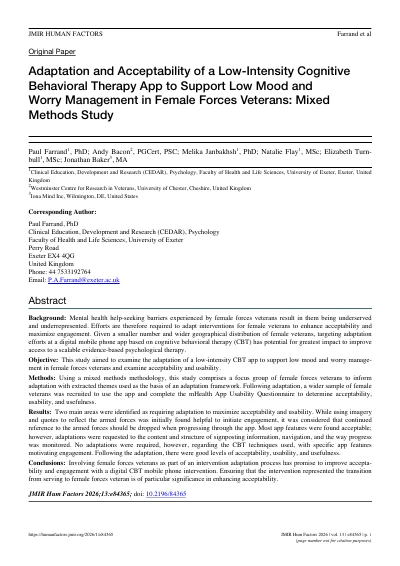
First page of the JMIR Human Factors adaptation and acceptability paper.Read paper
PublishedJMIR Human Factors · 29 April 2026

Adaptation and acceptability

Designing digital support with female forces veterans

Female veterans helped adapt IonaFFV, a smartphone app based on CBT for low mood and worry. Their feedback shaped language, imagery, navigation and signposting. Recognising the transition from military service to civilian life was especially important.

Mixed methods study5-phase adaptation process
Read the lay summary and study details

Female veterans can face barriers seeking mental health support. This can mean that existing services do not always meet their needs, and they may be less likely to engage with services. Support designed with female veterans may therefore be more relevant, acceptable and easier to use.

Female veterans first reviewed the app in discussion groups and suggested ways to improve it. The updated app was then shared with a wider group of female veterans, who gave feedback on how acceptable and easy it was to use. Participants suggested using images and quotations that better reflected women’s lives after leaving the Armed Forces, rather than focusing mainly on service in the Armed Forces. They also recommended clearer information about other sources of help.

The CBT activities and features designed to encourage regular use were received positively. The study shows that involving female veterans in adapting mental health support can help make it feel more relevant and engaging.

How to interpret this study: Five female forces veterans took part in the focus group, and 21 people completed the later demographic questionnaire; responses to individual usability questions varied. The small, self-selected sample limits generalisability. This was a study of adaptation, acceptability and usability; it did not establish clinical effectiveness.

Full publication

Adaptation and Acceptability of a Low-Intensity Cognitive Behavioral Therapy App to Support Low Mood and Worry Management in Female Forces Veterans: Mixed Methods Study.

Paul Farrand, Andy Bacon, Melika Janbakhsh, Natalie Flay, Elizabeth Turnbull, Jonathan Baker.

JMIR Human Factors (2026); 13:e84365. DOI: 10.2196/84365.

Open access under CC BY 4.0. PDF reproduced unchanged; first-page preview reduced from the original.
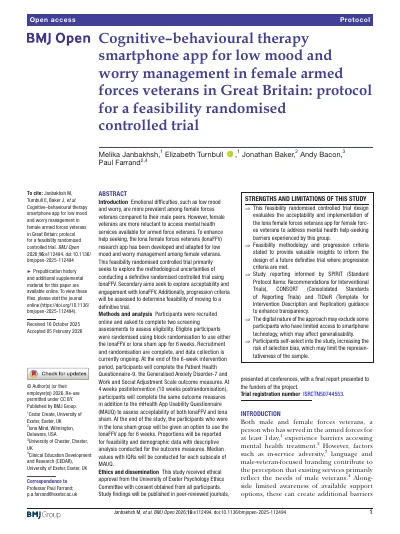
First page of the BMJ Open feasibility trial protocol.Read protocol
Published protocolBMJ Open · 6 March 2026

Planning a feasibility trial

A transparent framework for evaluating IonaFFV

This paper outlines the methods for a feasibility study to determine whether a larger trial of the app would be practical and acceptable. It sets out how the research app would be compared with a matched digital sham app.

Randomised controlled trial protocolMethods, not trial results
Read the lay summary and study details

Female veterans are more likely than male veterans to experience low mood and anxiety, but many do not use veteran-specific mental health services. Researchers have therefore developed IonaFFV, a smartphone app designed to help female veterans manage these difficulties.

The published protocol describes a double-blind feasibility randomised controlled trial. It examines recruitment, retention, app engagement, acceptability and study procedures to inform further evaluation and a future definitive trial. Publishing the protocol makes the study design and methods transparent.

The planned study compared six weeks of access to IonaFFV with a sham app, with follow-up at ten weeks after randomisation. The sham was designed to offer comparable functionality without the active CBT techniques.

How to interpret this paper: This is the trial protocol, not the outcomes report. Its target of 60 participants is a planned sample size. It does not report an achieved recruitment total or demonstrate treatment effectiveness.

Full publication

Cognitive–behavioural therapy smartphone app for low mood and worry management in female armed forces veterans in Great Britain: protocol for a feasibility randomised controlled trial.

Melika Janbakhsh, Elizabeth Turnbull, Jonathan Baker, Andy Bacon, Paul Farrand.

BMJ Open (2026); 16:e112494. DOI: 10.1136/bmjopen-2025-112494.

Trial registration: ISRCTN50744553.

Open access under CC BY 4.0. PDF reproduced unchanged; first-page preview reduced from the original.

Under reviewSubmitted to the Journal of Medical Internet Research

What the feasibility trial taught us

Learning what needs to change before a larger study

The study explored whether female veterans were willing to take part, whether they used the app and how they used it. It did not meet enough of its targets to show that a larger trial could go ahead without changes to the study design. There was also limited evidence that the app would improve emotional wellbeing in a larger trial.

Feasibility resultsNot yet a published journal article
Read the research team’s lay summary

Female veterans are more likely than male veterans to experience low mood and worry. Although many use mainstream NHS mental health services, fewer use services designed specifically for veterans. To make support easier to access, researchers adapted a smartphone app called IonaFFV based on CBT to help manage low mood and worry.

The app was originally designed for the general adult population and was adapted for female forces veterans. Researchers set targets for recruitment and app use to help decide whether a larger trial should go ahead. Recruiting participants was difficult, partly because some people who were not female forces veterans tried to join the study.

The comparison app, developed for female Armed Forces veterans, was found to be engaging and acceptable. However, the study did not meet enough of its targets to show that a larger trial could go ahead without changes to the study design. There was also limited evidence that the app would improve emotional wellbeing in a larger trial.

What this means: Findings do not give a final answer about whether the app works but do show that changes are needed before testing it in a larger study. This summary is provided by the research team while the manuscript is under review.

Manuscript

Smartphone CBT App for Managing Low Mood and Worry: Randomized Controlled Feasibility Trial on Female Armed Forces Veterans in Great Britain.

Paul Farrand, Melika Janbakhsh, Elizabeth Turnbull, Melanie Ponomarenko, Jonathan Baker, Andy Bacon.

Publication status: under review, as of November 2026.

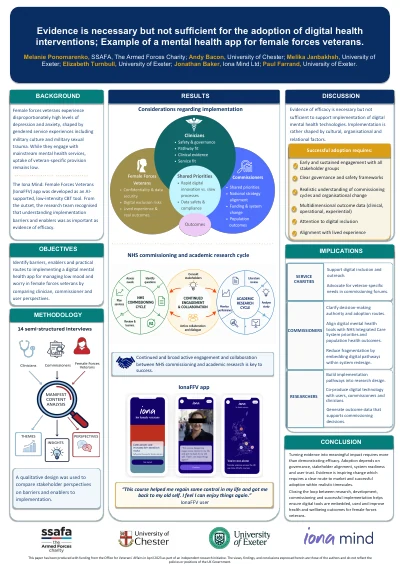
Implementation research poster on the adoption of digital health interventions.View poster
Conference posterCentre for Evidence for the Armed Forces Community · 2026

From evidence to adoption

What it takes to put digital mental health research into practice

The interviews showed that proving an app works is not enough on its own. Services also need to understand how it will fit into their organisation and have clear ways to keep people safe when using digital tools.

14 semi-structured interviewsClinicians, commissioners & female forces veterans
Read the lay summary and poster details

To help improve access to support, a smartphone app that offers low-intensity CBT has been developed for female forces veterans. The research team also wanted to understand what helps or prevents services from offering digital mental health support.

They interviewed clinicians, people who commission mental health services, and female forces veterans. The findings highlight governance, stakeholder alignment, digital inclusion, system readiness and user trust, alongside clinical evidence.

The study produced practical recommendations to help digital mental health support become more widely available for the Armed Forces veteran community. These implementation findings are not evidence that the app is clinically effective.

Poster

Evidence is necessary but not sufficient for the adoption of digital health interventions; Example of a mental health app for female forces veterans.

Melanie Ponomarenko, Andy Bacon, Melika Janbakhsh, Elizabeth Turnbull, Jonathan Baker, Paul Farrand.

Presented at the Centre for Evidence for the Armed Forces Community annual conference, London (2026).

03 / Key findings

Listen carefully.
Design thoughtfully.
Evaluate rigorously.

Lessons from the research programme, bringing together published findings, the feasibility manuscript under review and implementation research.

The current evidence

Current evidence of effectiveness is insufficient to support full implementation. Further evaluation is needed before wider adoption.

01Involve women throughout

Involve female Armed Forces veterans throughout the design and development of the intervention or service. This can improve fit with users’ needs and increase engagement.

Adaptation & acceptability study
02Recognise identity and transition

Use Armed Forces imagery and quotes to support initial engagement but reduce ongoing references to the Armed Forces as users engage further. This reflects women’s transition from serving personnel to veteran life.

Adaptation & acceptability study
03Make digital support easier to use

Retain most existing app features, but improve signposting to relevant information and support; make navigation simpler and more intuitive; and make progress tracking more meaningful and helpful.

The adaptation study did not identify a need to change the core CBT techniques. Many features were perceived as actively supporting continued engagement.

Adaptation & acceptability study
04Keep human support in the picture

Digital features can support female forces veterans to engage with intervention techniques. Participants also valued human support, including regular, scheduled contact alongside in-app support.

These are preferences reported by participants, rather than evidence that a particular support model improves outcomes.

Adaptation & acceptability study
05Plan for real-world adoption

Successful implementation is likely to depend on appropriate governance and information governance arrangements, alignment among key stakeholders, a clear route to adoption, and realistic development and evaluation timescales.

Implementation research poster
06Strengthen future trials

The feasibility work highlights the need to protect online recruitment, including considering measures such as CAPTCHA to reduce the impact of malicious bots.

The research team also reports that a digital sham control can achieve similar engagement, functionality and acceptability to the active intervention, supporting its use as a credible comparator. These trial findings are currently under review.

Feasibility manuscript · under review

04 / Research team

Clinical research meets
digital innovation.

A collaboration bringing together psychological therapies, technology and lived experience.

Professor Paul Farrand

University of Exeter

Professor Paul Farrand

PhD, PGDip, BSc(Hons)

Principal investigator

Professor of Evidence-Based Psychological Practice and Research within CEDAR; Psychology at the University of Exeter, and Co-Director of the Low Intensity CBT portfolio.

His work focuses on adapting psychological interventions to improve acceptability and engagement, with the Armed Forces community featuring prominently.

Read full biography

Paul Farrand is Professor of Evidence-Based Psychological Practice and Research within CEDAR; Psychology, a specialised group that focuses on psychological therapies research, training and implementation at the University of Exeter. He is Co-Director of the Low Intensity CBT (LiCBT) portfolio and has published over 120 peer-reviewed papers.

Given his international reputation and research in LiCBT, he is supporting implementation of LiCBT to improve access to evidence-based psychological therapies in the USA, Australia, Sweden, Quebec and Saudi Arabia and has membership of national NHS committees.

A large part of this work involves adapting LiCBT digital and written interventions to enhance acceptability and engagement for different groups with diversity. The Armed Forces community features prominently, with research supporting adaptation, training, service development and implementation for Armed Forces veteran-specific community and charity sector organisations in Great Britain, and for serving personnel in the Canadian Armed Forces.

Jonathan Baker

Iona Mind

Jonathan Baker

MA (Cantab)

Industry co-principal investigator

Technology entrepreneur, co-founder and chief executive of Iona Mind, and a graduate of Trinity College, University of Cambridge. He led the development of digital mental health tools at Iona Mind.

His research contributions include software development, statistical analysis of app log data to understand user engagement, and helping develop a matched digital placebo for controlled research.

Read full biography

Jonathan Baker is a technology entrepreneur and co-founder and chief executive of Iona Mind. He is also chief executive of AlgoViral, a social media marketing company and developer of getusers.ai, an AI agent for social media growth.

A graduate of Trinity College, University of Cambridge, he previously co-founded Simudyne, an AI simulation platform, serving as chief operating officer with responsibility for deploying its technology at global banks such as Barclays. He led the development of digital mental health tools at Iona Mind. Under his leadership, the company was selected for and funded by Y Combinator and raised venture capital from investors including Global Founders Capital, Rocket Internet, Session VC and Notion Capital.

He collaborates with Professor Paul Farrand and the University of Exeter on digital mental health research. His research contributions have included software development, statistical analysis of app log data to understand user engagement, and helping develop a matched digital placebo for controlled research.

He has co-authored peer-reviewed papers in journals such as BMJ Open, JMIR mHealth and uHealth, JMIR Human Factors and Academia Mental Health and Well-Being.

Research collaborators & co-authors

Andy BaconMelika JanbakhshElizabeth TurnbullNatalie FlayMelanie Ponomarenko

We thank the female forces veterans, clinicians, commissioners and stakeholder contributors whose perspectives shaped this research.

Continue the conversation

Research starts
with listening.

For questions about the programme, its findings or research collaboration, contact the research team.

Contact Professor Paul Farrand

This website shares research. It is not a treatment service or a route to enrol in a study.