
 Read paper
Adaptation and acceptability
Designing digital support with female forces veterans
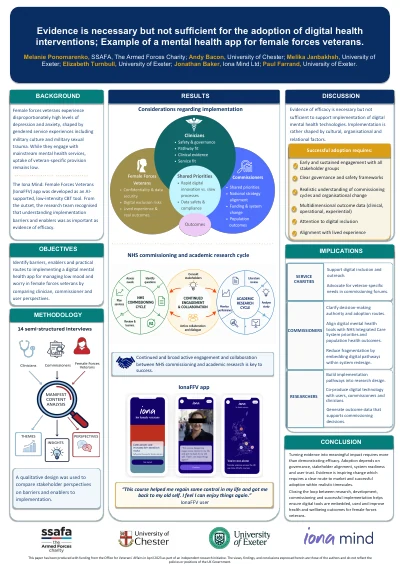
Female veterans helped adapt IonaFFV, a smartphone app based on CBT for low mood and worry. Their feedback shaped language, imagery, navigation and signposting. Recognising the transition from military service to civilian life was especially important.
Read the lay summary and study details
Female veterans can face barriers seeking mental health support. This can mean that existing services do not always meet their needs, and they may be less likely to engage with services. Support designed with female veterans may therefore be more relevant, acceptable and easier to use.
Female veterans first reviewed the app in discussion groups and suggested ways to improve it. The updated app was then shared with a wider group of female veterans, who gave feedback on how acceptable and easy it was to use. Participants suggested using images and quotations that better reflected women’s lives after leaving the Armed Forces, rather than focusing mainly on service in the Armed Forces. They also recommended clearer information about other sources of help.
The CBT activities and features designed to encourage regular use were received positively. The study shows that involving female veterans in adapting mental health support can help make it feel more relevant and engaging.
How to interpret this study: Five female forces veterans took part in the focus group, and 21 people completed the later demographic questionnaire; responses to individual usability questions varied. The small, self-selected sample limits generalisability. This was a study of adaptation, acceptability and usability; it did not establish clinical effectiveness.
Full publication
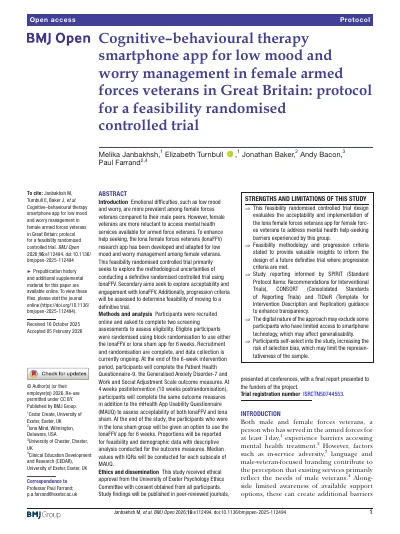
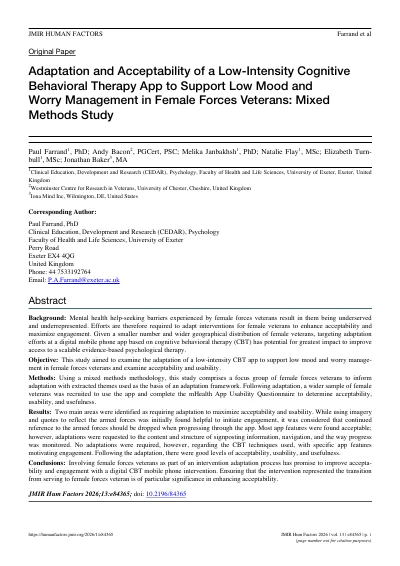
Adaptation and Acceptability of a Low-Intensity Cognitive Behavioral Therapy App to Support Low Mood and Worry Management in Female Forces Veterans: Mixed Methods Study.
Paul Farrand, Andy Bacon, Melika Janbakhsh, Natalie Flay, Elizabeth Turnbull, Jonathan Baker.
JMIR Human Factors (2026); 13:e84365. DOI: 10.2196/84365.
Open access under CC BY 4.0. PDF reproduced unchanged; first-page preview reduced from the original.